How do you deliver aid in Ukraine when your team has just one vehicle left?
“The hardest part is providing aid in the place you call home,” says our colleague Yuliia from the Sumy region. In this interview, she explains why she travels hundreds of kilometres every month and how losing a vehicle in a drone attack has made our aid work in Ukraine more difficult.
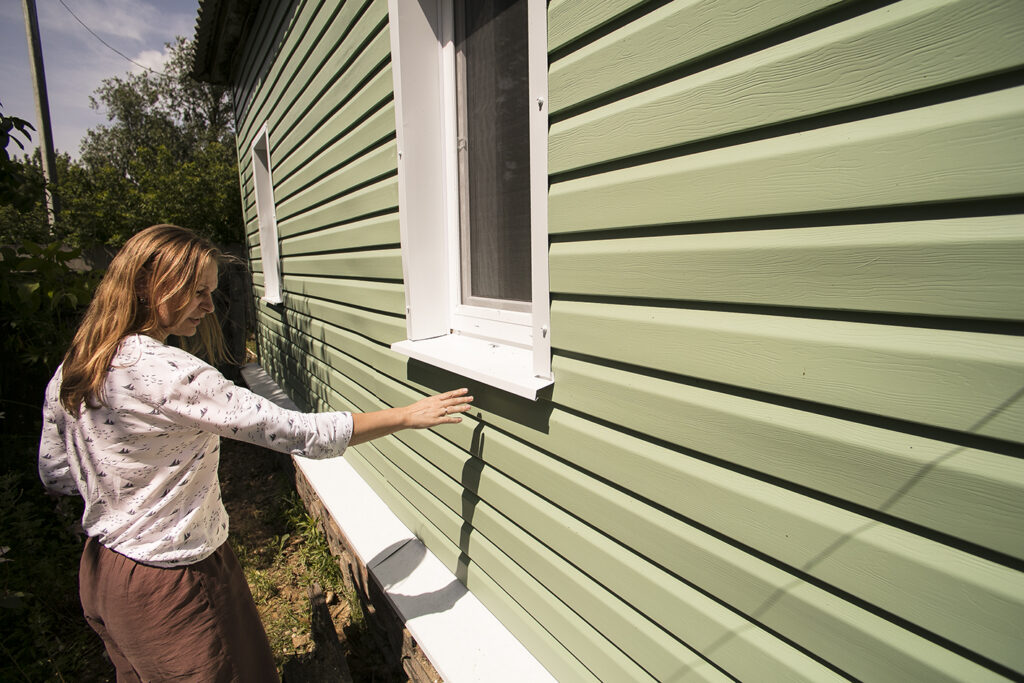
We arrived at Halyna’s home to replace the windows. Only once we were there did it become clear that the house needed more extensive repairs. In another village, equipping an air raid shelter helped keep a kindergarten open when it was at risk of closure. We provided Liubov’s family with new household appliances, including a washing machine, a fridge and a cooker. With a working oven, she could once again bake the children’s favourite Easter bread. Behind every such outcome are visits, conversations with people, assessments of their needs and return visits to check that the assistance is working as intended.
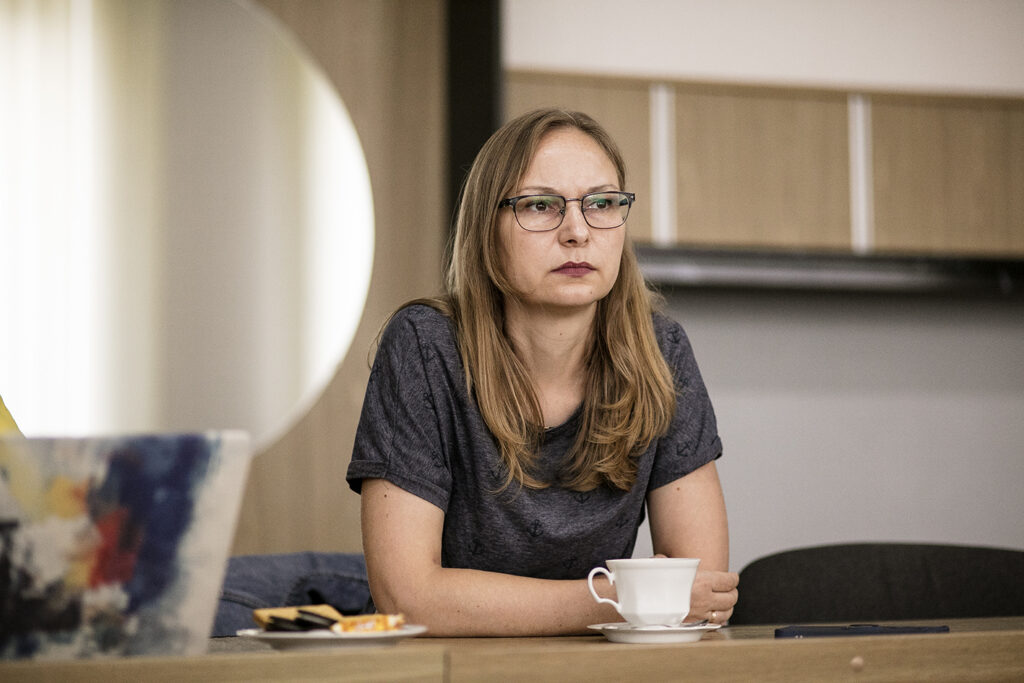
Our colleague Yuliia Tsyba, a People in Peril field worker in Ukraine, travelled approximately 1,770 kilometres in August alone. She visits households, collective centres, schools, kindergartens and shelters, identifies what people need and helps find solutions. She lives with her family in the Sumy region, so the war also affects places and people she has known all her life.
During a drone attack in the Chernihiv region in May, we lost one of our two work vehicles. Fortunately, no one on the team suffered any physical injuries. However, this left us with just one vehicle for our two offices and field visits. That is why we launched a fundraising campaign to replace the destroyed vehicle and safety equipment, so we can continue reaching people who need our help.
We spoke to Yuliia about how we decide whom to help, what we cannot learn over the phone and why we need to keep returning to the people we support.
Helping starts with being there in person
Where did your most recent work trip in Ukraine take you, and what was its purpose?
I travel for work so often that by the time this article is published, the answer to this question will have changed at least five times. I make several field visits a week, sometimes heading out every day. The aim is always to be there in person and make sure our assistance is as well targeted as possible and reaches the people who need it most.
How do we identify where our help is needed most?
First, we gather requests from communities, local and regional authorities, partner organisations and humanitarian coordination groups. Once we have a specific project and an agreed budget, we go into the field to verify the needs in person. Simply being told that a school shelter needs repairs or that windows need replacing is not enough. We want to see what the situation is really like and where our assistance can make the greatest difference.
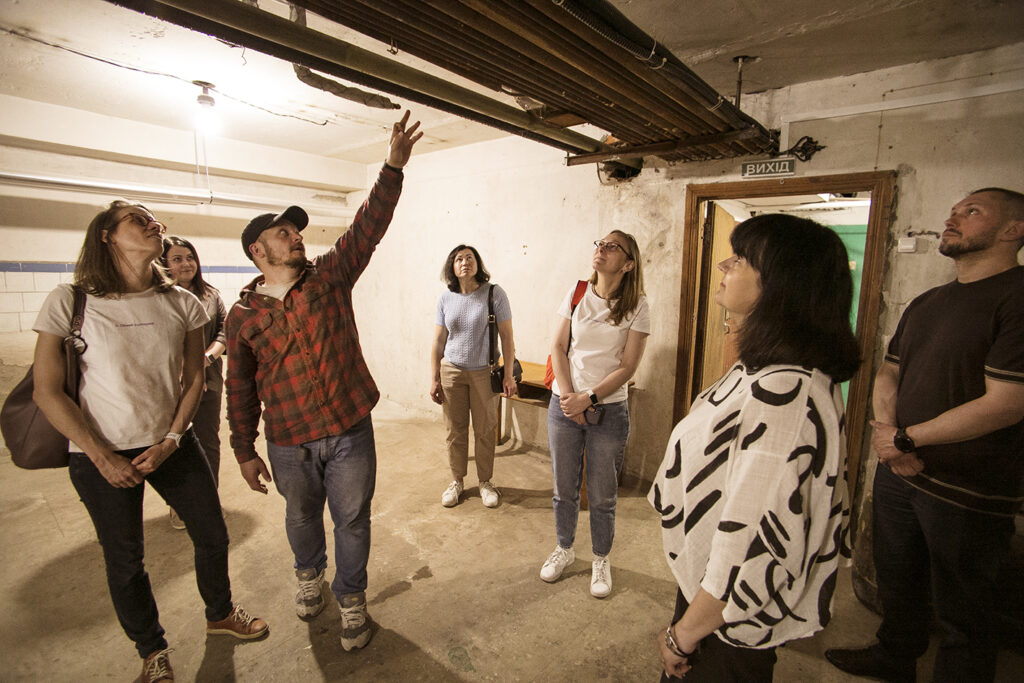
For example, I personally visited all the shelters at schools and kindergartens that had been identified as needing repairs. We assessed their actual condition and selected the places where our support would have the greatest impact within the available budget.
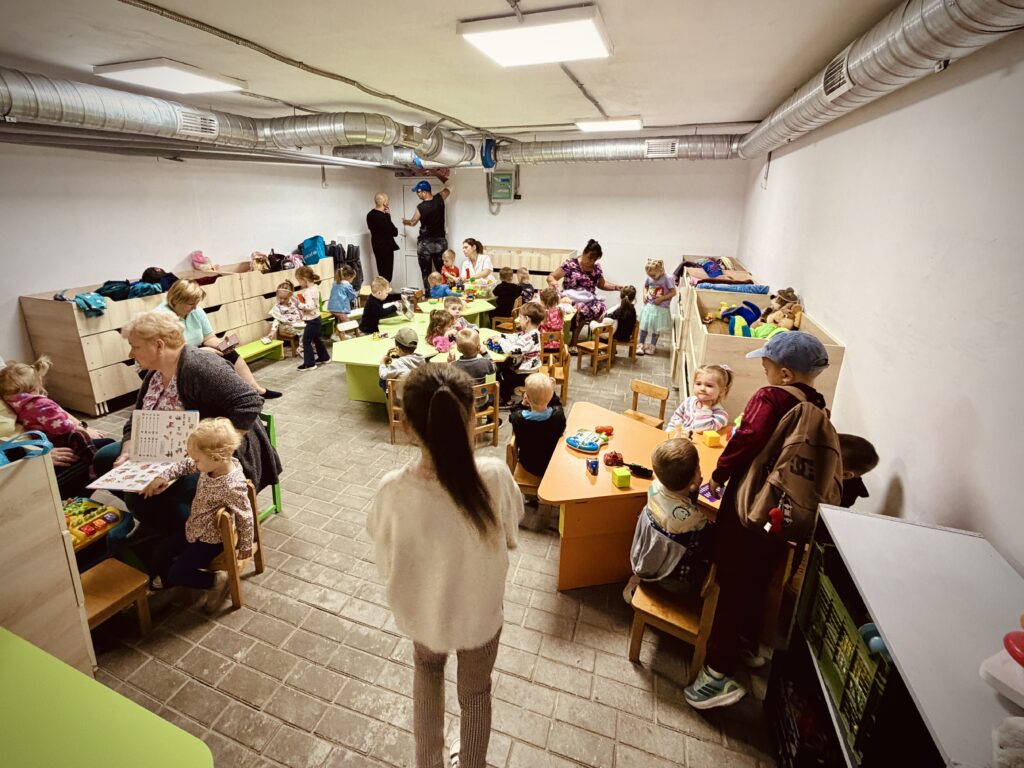
A good example is the kindergarten in Bobrovytsya. Around 50 children attended, but its shelter was essentially just a basic cellar with plastered walls. The kindergarten was in an industrial area on the outskirts, where there were fewer children, and the municipality did not have enough funding to support it. It was therefore at risk of closure. Our assistance, however, significantly improved conditions. We equipped the shelter so that children could stay there safely, play and rest, allowing the kindergarten to remain open.
When making decisions, we therefore look beyond places where something needs repairing. We also consider where even relatively limited assistance can substantially improve people’s lives, for example by preventing a kindergarten from closing or enabling children to attend school more regularly.
What happens during our first visit to a household, home or school we want to support? What do we assess on site, and how do we involve people themselves in the planning?
It all starts with communication and arranging a visit. When we arrive, we first introduce ourselves, talk to people and learn about their needs. Not just the one they originally approached us about, but all their needs. We then work together to identify an area where we can make a real difference.
Next, we inspect the site, whether it is a house, a school or a shelter. When visiting households, we also look into other circumstances, such as whether the home was damaged in an attack, who lives there, whether the person has the necessary documents and whether they can access other available assistance. We try to prioritise people who are vulnerable and have no one else to turn to for help.
The hardest part is saying we cannot help
When we cannot help everyone, how do we choose which households or schools to support? What is the hardest part of that decision?
When we cannot help everyone, we primarily consider how vulnerable a particular household or community is, whether people have other ways to access assistance and what difference our support could actually make. The budget is also an important factor. Although we cannot fund large projects worth millions, we try to use the resources available where they will help the most.
For households, a key consideration is whether people can access other government or humanitarian assistance. When assessing damaged homes, for example, we met people who could apply for support through the “eVidnovlennia” (“eRecovery”) programme. This government initiative provides Ukrainians with compensation for housing destroyed or damaged by the war. If someone has all the necessary property documents, they can receive funding through the programme to replace damaged windows. In such cases, we try to prioritise someone who does not have that option.
For example, we met a woman who had lived in her home all her life. After her husband died, she could not afford to complete the inheritance process and transfer the property into her name. Although she continued to live there, the missing documents meant she could not access eRecovery support. These are precisely the people we want to help: those who are particularly vulnerable and have no other way to resolve their situation.
We also have to assess whether our assistance will actually solve the problem. For example, we declined to replace the windows in a house that was structurally unsafe. New windows alone would not have helped because the foundations were also crumbling. There is no point in investing in a partial repair if we know the house will remain uninhabitable afterwards.
The hardest part is deciding that we cannot provide someone with assistance. When you meet a person face to face and know their situation, saying “no” is not easy. But we only make that decision when there is a reason: we know our assistance would not solve the problem, or the person can get support elsewhere. We try to turn away as few people as possible who have no other options.
We originally went to Bondari to replace windows, but Halyna’s home needed more extensive repairs. How do we decide whether we can do more than we planned?
We initially arrived with a specific plan: to replace the windows. But when we saw the condition of the house, we realised that replacing the windows alone would not adequately address the situation. We assessed all the needs alongside the available budget and found that we also had enough funding to repair and insulate the house. If our own funds had not been sufficient, we would have looked for other options, for example through another project or a partner organisation. We did not want to simply leave after replacing the windows if we could do more.
We worked with the municipality on repairs to Halyna’s home and with a partner organisation on the school shelter. How do we divide the work so that our efforts complement one another?
We try to divide specific tasks and costs according to what each party can provide. At Halyna’s home, for example, the municipality repaired the damaged roof using its own resources, while we replaced the windows and later insulated the house.
For the joint shelter renovation, we agreed with our partner organisation to share the funding and divide the work. Each partner was responsible for its own part and the associated costs. Throughout the process, our teams and departments stayed in contact and coordinated their work. This allows us to combine our resources and capabilities.
Hundreds of kilometres behind our work
K opravenému domu či odovzdaniu vybavenia vedie viacero návštev. ČoRepairing a home or handing over equipment involves several visits. What do we check during these visits, and how do we verify afterwards that the assistance is truly meeting people’s needs?
We monitor the entire process from start to finish. When replacing windows, for example, we begin with an initial assessment, then sign an agreement with each household. We then check that the work is progressing on schedule and meeting the required quality standards. We make additional monitoring visits as needed.
Once the work is complete, we visit every household again and sign a document confirming completion. For the window replacement project, this meant at least three visits to each household.
What can you learn from meeting people in person that would be difficult to find out from photographs or a phone call? Can you recall a specific situation?
An in-person visit often reveals that the actual needs are much greater or different from those described in the original request. On one project, for example, I was told that windows needed replacing in some flats. But when I arrived, I discovered that the flats were uninhabitable at the time. Replacing the windows alone would therefore not have solved the problem.
So I spoke to people in the community about their plans. It turned out that the municipality wanted to renovate the flats and use them to accommodate internally displaced people. That conversation allowed us to explore further ways to help, such as providing heating systems for four flats.
We have offices in Uzhhorod and Kyiv, while you live in the Sumy region. Roughly how many field visits do we make each year, and what do we use the vehicle for during these trips?
I cannot give an exact number of work trips per year, but I can illustrate it with my own experience in August. I drove approximately 1,770 kilometres in our work vehicle and spent 10 days in the field. Multiply that by 12 months and you can see that fieldwork makes up a significant part of my job. Having a work vehicle is what allows me to do it well and on time.
The vehicle is essential for assessing needs, visiting households and communities, checking work in progress, talking to people and inspecting completed projects. Without it, I think carrying out this work in the field would be practically impossible, and I would have to rely mainly on phone calls.
The vehicle also needs to cope with difficult terrain. Roads to some remote areas are in very poor condition. For example, a stretch of roughly ten kilometres to one village in the Sumy region took me more than half an hour to drive. I cannot use my own car for these trips because its ground clearance is too low for many of the roads there.
And, of course, the vehicle’s size matters too. We need a spacious boot because we often transport humanitarian supplies or materials needed for individual projects. We also need room for protective gear and other equipment, such as bulletproof vests, helmets, sleeping bags and first aid kits, which our staff must carry on work trips.
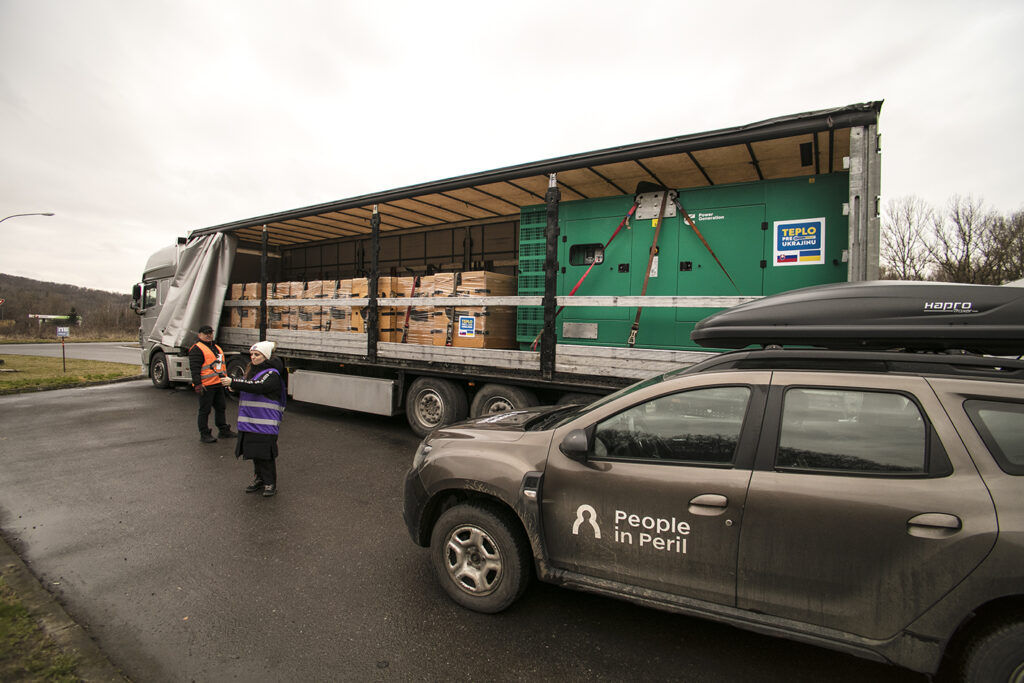
How does the security situation affect our plans? When do we have to decide to postpone a trip or turn back?
The security situation in the areas where we work has deteriorated significantly, particularly in the Chernihiv and Sumy regions. Attacks on infrastructure, including the railways, have intensified, making travel more difficult. Prolonged power cuts disrupt phone and internet connections, and navigation systems often fail too. While travelling through the Sumy region, we have repeatedly found ourselves unsure whether we were heading in the right direction because we could neither rely on navigation nor contact anyone.
The constant shelling also has a major impact on our logistics: routes become dangerous or inaccessible, deliveries are delayed, and we often have to change our work plans at the last minute. The Russian army attacks major cities and surrounding areas with long-range drones almost every day. This poses a serious threat to our team’s health and lives.
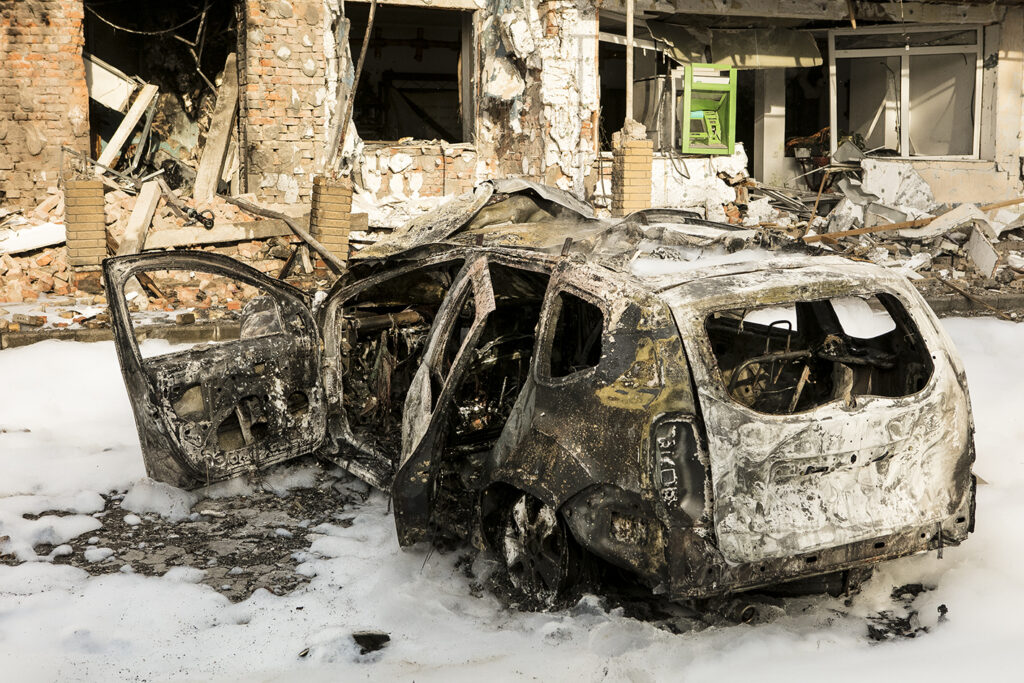
We experienced this ourselves when a drone destroyed our work vehicle during a trip to the Chernihiv region. Fortunately, no one on the team suffered any physical injuries, but we had to make major changes to our plans for the week-long trip. Over several days, we were due to drive through three regions — Kyiv, Chernihiv and Sumy — covering a combined area of 83,830 km². Everything had been planned and agreed with our partners, local authorities and the people we support. Then suddenly, in a single second, the vehicle and the humanitarian supplies it was carrying were gone.
So yes, sudden changes of plan are unfortunately part of our work, as is cancelling a trip altogether when the security situation requires it. We have a security coordinator on our team whose role is to monitor the situation daily in the regions where we work and decide whether a trip can go ahead. Our organisation also has security procedures that we must follow during work trips.
Ukraine is also your home. What is it like to help others when the war affects your own life too?
It is very hard. The hardest part is providing aid in the place you call home. You know the streets, the houses and the people. Not long ago, you were sitting there with friends, or it was somewhere you used to play as a child. Then suddenly you hear that an attack has struck that very place, and you know who lives in those houses.
That is why providing aid in the Sumy region is deeply personal for me. When I see that a hospital, heating system or essential services cannot function without a generator, I know from my own experience what that means for local people. I know what it is like to be without electricity and heating, or to arrive at a healthcare facility that cannot operate because the power or internet is down.
That is also why I believe it is so important to help people meet their basic needs and ensure that hospitals, clinics, schools and other services can keep running.
Is there an encounter with people we have helped that you think back to when you need to find strength?
Yes. Seeing the results of our work encourages me the most. After the windows had been replaced, I visited the households and did not receive a single piece of negative feedback. People were happy and appreciated the quality of the work.
Visiting a school shelter is also a powerful experience for me. When I see a school full of children and the joy in the headteacher’s eyes as she looks at the results, I share her happiness. I felt even more encouraged when I learned that the renovated shelter in Konotop allows children to attend school in person much more often. Previously, they spent one week at school followed by six weeks learning online. Now, each week at school is followed by just two weeks online.
It is equally moving to see a kindergarten that I first visited when renovation work was just beginning, and then return to find it full of children. These tangible results give me the energy to keep going.
In the drone attack in May, we lost one of our two work vehicles as well as the team’s safety equipment. We are now raising money to replace them. What specific difference would donors’ support make to our team and the people we visit?
As I mentioned, a reliable work vehicle is essential for fieldwork. It allows us to reach people in person, assess their needs, check the progress and quality of the work and verify that our assistance is serving its purpose. The vehicle also needs to be mechanically reliable and capable of handling difficult terrain, as we often travel to remote areas along roads in very poor condition. It enables us to stay in direct contact with people and respond to their actual needs, rather than relying solely on information shared over the phone.
We currently have just one vehicle for our entire Ukraine team and two offices more than 800 kilometres apart. I use it because I need to travel frequently between the Sumy and Chernihiv regions. Our colleagues from Uzhhorod, Kyiv and Slovakia therefore rely on public transport, mainly trains and buses, both to reach the areas where we work and to travel locally once they arrive.
However, trains in Ukraine currently face frequent major delays or fail to reach their destinations because Russia is heavily attacking railway infrastructure and civilian trains. For example, on 9 September, drones struck a train carrying civilians in the Sumy region. The locomotive and a passenger carriage caught fire, and preliminary reports indicated that ten people were injured. While rescuers were responding at the scene, the enemy attacked again. Relying on public transport for our work is therefore neither particularly safe nor reliable.
Donors’ support would help us secure another vehicle and continue making regular visits to the people we support. We could plan trips more flexibly, maintain personal contact with people and provide assistance where it is needed most.