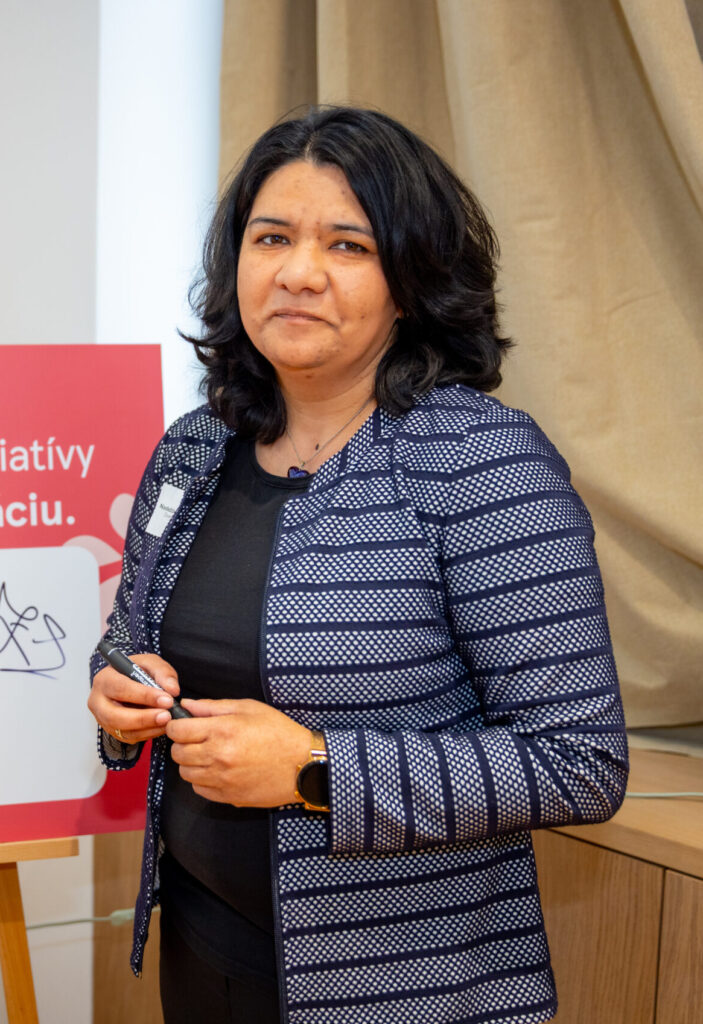
People Behind People in Peril — Nadežda Malčeková: Being Roma isn’t what matters. What matters is how we see people.
As part of our interview series Person to Person, we spoke with Nadežda Malčeková, our Social Inclusion and Employment Manager.
She started at People in Peril as an employment programme assistant, working directly with clients to help them find work and overcome the barriers they faced along the way. Today, she is our Social Inclusion and Employment Manager and meets more frequently with employers. She reaches out to companies, explores opportunities for cooperation and helps them better understand the people they could employ.
As she explains, the employment programme works with both sides: employees and employers. In her view, both need trust, support and understanding.
In the interview, he also talks about:
- how her own experience of sitting at the “dunce’s desk” shaped her approach to children,
- why children need to feel valued by their teacher,
- why both jobseekers and employers need support,
- how helping others taught her to set her own boundaries.
People Behind People in Peril interview series offers a closer look at the people behind People in Peril and the humanitarian work it delivers. It introduces both those working on the ground and those coordinating relief efforts behind the scenes. Through their stories, motivations, and everyday challenges, the series shows that every act of assistance is made possible by ordinary people who have chosen to do extraordinary work.
When we first met a few months ago, you jokingly introduced yourself as a client. Do you often joke about your background?
I mostly use humour to break the ice. When I meet someone new, I like to play a little joke on them, and sometimes they end up being the target of more of my attempts at humour (laughs). I occasionally do this with employers, too.
Often, they only speak to me on the phone at first, so they haven’t seen me. When I arrive for a meeting, some are surprised. I act as though nothing has happened, or sometimes pretend I’m leaving. That’s when they collect themselves and realise I’m the person they spoke to on the phone and arranged to meet. It’s also a way for me to gauge an employer’s attitude towards people from marginalised Roma communities.
I had an experience like that recently. I contacted an employer in Bratislava — I won’t name him. I’d seen that he was advertising cleaning jobs and looking for support staff. I introduced myself and explained our programme and what we do. When I mentioned people from Ukraine, he stopped me straight away. He said he wasn’t interested in employing people from Ukraine or marginalised Roma communities. He was quite unpleasant.
I admit I had to make a real effort to keep my composure. Still, I remained polite, thanked him and ended the conversation. It took me a while to process it. About an hour later, he called me back and invited me for coffee. He had reflected on how our conversation had gone and wanted to revisit the subject. Of course, I accepted.
He told me beforehand that he would be wearing shorts and a white T-shirt, so I knew who to look for. When I approached his table, I asked whether the seat was free. He said it wasn’t. I thought, “Fine.” I thanked him and turned to leave. Only then did he realise I was the woman he had arranged to meet. He was surprised that I was Roma.
The meeting itself was much better and more pleasant. He was very interested in our employment programme and what we do. We even explored possibilities for working together.
Do you also use humour when working with clients, for example in more difficult situations?
Not so much with clients. I tend to be the strict one, the “bad cop”, and I prefer my colleagues to be the good ones. They are in more frequent contact with clients, so I try to strengthen the trust between them and encourage clients to communicate more openly with them. I’m strict Naďa.
Of course, I sometimes say something to lighten the mood when I see how they’re reacting. My humour is a little different then — more subtle.
The children shaped me, too
Before joining People in Peril, you worked with children for more than twelve years. How did you get into that work?
I always wanted to teach. It used to be a dream of mine. But I never thought I would stay in it for so long. I worked with children for more than twelve years, including nine at my last school.
For me, children open the door to reaching their parents. Every parent cares about their children in some way. Some give them everything they can; others can only give what they themselves received growing up. For us Roma, children are incredibly precious. They are our future, and we invest everything in them. We may do it in our own way, but we give them all we can.
Through the children, I was able to communicate much better with their parents. Gradually, they began to realise that their children had talents — whether in sport, maths, dance or music. Some had previously been in special education classes but were later moved into mainstream classes. Today, they are secondary school students or people working abroad or here in Slovakia. I’m grateful that they still think of me from time to time.
That influence went both ways: I helped the children, but they also shaped me. I gradually became a better, more perceptive person. Although I come from the same community, this work helped me get to know them better, too.
We often laughed when we sat in a circle around a candle and talked about our feelings. They were already in the upper years of primary school, but sometimes they would slip up and call me “Mum”. We would all collapse with laughter. Looking back now, I realise I was truly happy during that time. They filled a void and gave me a sense of what it feels like to be a mother.
Did you mainly work with children from marginalised Roma communities?
At first, yes. But I realised I couldn’t work with just one group when there were so many other children at the school. I organised football, floorball and dodgeball tournaments that brought them together.
When a group of children — both Roma and non-Roma — came to me, I would motivate them by reminding them that the end of term was approaching and they had tests coming up. I wanted everyone to get at least a passing grade and those who were doing better to improve further. The children helped one another, and I organised a tournament as a reward. We also had a dance club where we did folk and Roma dances. They understood that they had to work as one team.
What exactly did you teach the children?
I worked as a teaching assistant in the upper years of primary school, so I would support pupils during lessons such as maths or Slovak. This may surprise some people, but when Roma children get the attention and support they need, they do well at maths. I don’t mean the most difficult things, like logarithms, but they handled everyday calculations without any problems. Once they mastered their times tables, which they initially found difficult to grasp, they were fine.
I made various learning aids to help them, and they showed just how much talent and ability they had. Above all, these children need a teacher who treats them with humanity. Someone who is inclusive and sees them as individuals, rather than just seeing the community or family they come from, or remembering that their brother caused trouble at school. They need to feel valued by their teacher.
I didn’t want children to go through what I had experienced
Did you also draw on your own experiences at school? Did you try to treat the children differently from the way your teachers had treated you?
Yes. I went to primary school during the socialist era. I sat right at the back, at the so-called “dunce’s desk”, usually on my own. Whenever someone misbehaved and disrupted the class, they would be made to sit next to me as punishment. But they were quiet around me because I could be a bit of a fighter and wouldn’t let anyone push me around. There were times when I hit someone with a ruler.
As a child, though, I desperately wanted a teacher to recognise me and notice that I had talents, too. It feels awful to sit in a classroom while the teacher praises everyone else and reads out the test results, and you’re always the worst. I would just shrink down behind my desk at the back. I longed to be praised just once, even for a middling grade — to hear that I had tried hard and that someone was rooting for me.
That was exactly the kind of atmosphere I tried to create in the classroom. I wanted classmates to praise a pupil who was at risk of having to repeat the year, for example, when they managed to pass a test, even with a lower grade. The children would celebrate that pupil’s success even more than their own higher marks. It brought the class closer together and helped everyone move forward.
I called the children my “little chicks”. When I was at school, it was common for a teacher to call a Roma child a “Gypsy”, while addressing the other children kindly by name. I wanted to make sure the children in my care never experienced what I had been through.
Was working with children also a way for you to process your own difficult experiences at school?
No, it wasn’t about healing. It was more that, having experienced disappointment and pain myself, I didn’t want anyone else to have to go through the same thing. I didn’t want the children I worked with in years five to nine to experience what I had at school.
That doesn’t mean I never raised my voice. Of course, I was strict with them, too. But I would take a child aside into the corridor, where we could talk privately. If a gentle approach didn’t work, I would ask them to think things over. To some extent, I was the one who said “no”. But after a while, the child would come back, able to reflect on the situation for themselves.
I never spoke badly of the children to their parents. When parents came to parent–teacher meetings or were called in by the headteacher, I praised their children wholeheartedly. Sometimes I would call to tell them their son had earned a good or satisfactory mark. They were delighted and said no teacher had ever praised their child like that before.
Previously, they had been afraid to answer the phone when they saw the school calling. They expected to hear that their child had got into trouble again — fighting, leaving school without permission or skipping PE. Instead, I would praise their child for being a wonderful dancer or singing beautifully and confidently. This helped parents see their children in a positive light and take an even greater interest in them.
Did that help parents see more value in school and education?
Definitely. When I joined the school, a large proportion of the children in the year-five class were Roma. By the time they finished primary school, all of them went on to secondary vocational schools, which made me incredibly happy. I’m very proud of them. I know that two of the girls even decided to become teaching assistants. I really hope they stayed with it.
Did you feel that the children saw you as a role model?
That was never what I wanted. I always told them — and we tell some of our clients this, too — that they had to be even better than me. That’s the right motivation. If they try to be like me, they’ll only be good. They need to be even better; otherwise, they’ll only achieve what I’ve already achieved.
What do you think schools still get wrong when educating children from socially disadvantaged backgrounds? Where do they make the biggest mistake?
It’s difficult to generalise because so much depends on the school leadership’s approach. But it’s important that both the class teacher and the other teachers who teach the class see the children as whole people.
Sometimes, we adults don’t even need to say anything. When someone walks into a classroom, children pick up on their attitude and immediately say, “This teacher doesn’t like us.” They’ll accept a strict teacher, but they need to sense their humanity. If there’s no willingness to connect and no spark, a child develops their own defence mechanism. That happens very often.
Teachers should also understand a child’s family circumstances. At school, they may be a pupil, but they are still a child who brings experiences from home with them. Perhaps there isn’t enough food at home. Perhaps it was raining and they had nothing suitable to wear, so they didn’t come to school. Discussing these reasons for absence in front of the whole class is deeply humiliating. I see it as public humiliation. A child will either lower their head and stay silent or lash out to defend themselves. We should try to understand children and respect them as they are — above all, they are children, not adults.
What made you leave the school after so many years?
I worked at my last school for a very long time. I would arrive before six in the morning and leave after seven in the evening. Those weren’t my required hours, but when I first joined, the children would rush off to catch the bus home at noon. They weren’t just Roma children, but other children from socially disadvantaged backgrounds, too.
So I started coming up with clubs and activities. But it wasn’t just about clubs. We might spend an hour studying together first. When children who were good at maths or English came along, I would tell them they would be my assistants and that we would all help one another. I wouldn’t leave until the evening, when my husband came to pick me up and the children caught the last bus home.
When you stay in one place for too long, push yourself to the limit and give it everything, you eventually have nothing left to give. I could see that the class had developed a wonderful team spirit. The teachers had also understood that they needed to do more than simply accept the children: they needed to embrace them for who they were, rather than try to mould them against their will. I felt I had given all I could there.
People in Peril found me
How did you come to join People in Peril?
People in Peril found me, through Miška Mudroňová (editor’s note: Head of the Employment Programme). We happened to meet at an event. I don’t know what won her over, but I was essentially out of work at the time, and Miška offered me a job on the spot. I couldn’t believe it, but she tempted me.
What won me over was that she had never met me before, had never heard of me or even seen my CV, yet she still offered me a job. That had never happened to me in Bratislava before. I had been going from door to door, looking for work without success. That’s another reason why I understand our clients so well today.
Miška’s gesture made me think seriously about the offer. Although I initially said no, the way she approached me really sparked my interest. I have never regretted my decision.
I started as an employment programme assistant. It was demanding, and the whole web of paperwork sometimes put me off. I’ll be honest: I don’t like working with spreadsheets. But once I saw how the programme worked, I realised it was somewhere I could work closely with people again — not just Roma people, but anyone who needed help. I stepped aboard a boat that has been taking me wherever it chooses ever since.
Today, you are our Social Inclusion and Employment Manager. What does your work involve?
To be honest, sometimes I do things I’m not supposed to do, too (laughs). My main role is to contact employers and help them understand the people they employ. It’s not simply a matter of hiring someone and immediately dismissing them if they don’t turn up for work.
Employers need to know their employees. That’s why our programme works with both clients and employers. I often say that an employer is like something living that we need to shape, which can sometimes be very challenging.
I also try to support my colleagues. I’m the coordinator who contacts companies and organisations, but most of the work falls on my colleagues in the field. I want to ease their workload at least occasionally and stand by them when they need it most.
Does your coordination role mean you spend most of your time in the office, or do you still go out into the field?
Not at all. I’m not the kind of person who likes sitting in an office. When I first joined, we often joked that Miška had to set limits on how far I could go. Before anyone knew it, I would be in a completely different area, already working with clients there. I love going out into the field.
Employers, whether they are new contacts or already working with us, really appreciate a personal visit. Personal contact and persistence matter to them. Often, when they close the door on me, I go in through the window. Eventually, it sparks their interest and they ask why we do this. We do it so they can find employees and those people can find their own sense of direction. I ask employers to help us with that process.
Some smile and say no. But I come back after a while, and eventually we do end up working together. With some, it takes a very long time for them to understand. Everything takes time.
We couldn’t find the body
Let’s go back to your early days at the organisation, when you worked directly with clients. Your colleagues have told me that some used to call you in the middle of the night. How did you start setting boundaries?
That happened mostly at the beginning. I had lots of energy, wanted to do everything I could for my clients and, in a way, forgot about myself. It forced me to stop and set clear rules and boundaries. We learn best from our own mistakes and missteps.
Today, I have boundaries with clients and employers that I don’t cross. I still work with clients to some extent, but those boundaries are firm. As a Roma woman, I initially found it very difficult to say “no” to someone from a marginalised Roma community. I’ve been out of work myself, I come from a background of generational poverty, and I know the difficult days they face. That has stayed with me.
But I realised that if I really wanted to help, I needed to take a different approach: recognise their potential to move forward and insist that we stick to what we agree on. When we say no, we have to mean it. I mustn’t cross those boundaries.
These days, clients know I won’t answer the phone at night. But I remember one funny incident, although it wasn’t intentional on my part. I had forgotten to put my phone on silent, and someone called me in the middle of the night. I answered, barely awake, and a voice on the other end said, “We couldn’t find the body.” Half asleep, I replied, “Right, then call the police.”
The man said, “You don’t understand…” By then, I was awake and started asking who they were and what was going on. I won’t name the location, but they were workers who cleaned trains and were looking for one of their colleagues. I told them, “All right, step back a little and see whether there’s a train parked somewhere nearby.” They said all the trains had left. I insisted they look again, properly, because there had to be something there. They looked around the station and said, “Actually, there is one still here.” I told them to go inside and check whether their colleague might be lying there asleep. And there he was. He was simply exhausted and sleeping soundly.
I admit, though, that being woken up by the words “We couldn’t find the body” completely floored me (laughs). Ever since, I double-check every evening that my phone is on silent.
Does your background help clients relate to you? Does it make it easier to build trust with them?
I don’t think being Roma is what matters. It’s more about how we see people. Do we see them as members of society who need help, or as people who are simply taking advantage of the system?
It also matters whether we value them and, regardless of their circumstances, show them respect in the way we speak to them and view them. When we interact, I’m very careful not to make them feel pitied. I treat them as equals.
It’s very important to me that, through our conversations, they begin to recognise the possibilities open to them. From the first meeting, I notice how they communicate with me, how they answer and where they look. I don’t pay attention to their clothes or how they sit. What matters to me is that initial connection — eye contact and how they express themselves.
We need to learn to address our own prejudices
What tends to be the biggest barrier for someone who wants to find work? A lack of education or experience, the way the system works, or prejudice?
None of those can be ruled out. It’s a whole combination of problems. Even someone with an education can face a systemic barrier — for example, being unable to arrange childcare because their child hasn’t been offered a place at kindergarten. They have to deal with all these problems, and it’s very sad when they are left to do so alone.
Of course, someone may think they are being brave when they come in, lash out verbally and show how supposedly strong they are. In reality, they may be among the most vulnerable people we work with. Simply attending a job interview for the first time in their life and experiencing what that feels like is a huge step.
But the biggest problem is how society sees people from socially disadvantaged backgrounds or marginalised Roma communities. Unless we recognise that, regardless of where they come from, they have goodness and talent within them, nothing will change. We cannot keep seeing them only as lazy people who don’t want to work and exploit the system.
We need to learn to address our own prejudices; otherwise, these people won’t get a chance. Even if we say nothing, they will sense them. People living in generational poverty, struggling to survive from one day to the next, have an incredibly keen sense of other people’s attitudes and pick up on them immediately.
If we really want to work with them, we need to see them differently. What I like about our organisation is that we see much more than their social status. Working in the employment programme has taught me that even when someone fails, they still get another chance. In the mainstream system, they often don’t.
Clients tell us, “I’ve already worked for this employer and they dismissed me, or they didn’t respond to my CV, and now I’m supposed to go back?” They need reassurance that they are not alone and that someone believes in them.
I accompanied a woman to an interview who told me, “I’ve already sent my CV here, had an interview and been turned down. Now I’m going back with you?” I replied, “Yes, this time you’re going with me, and there are two of us. There’s only one of her on the other side of the table.” She laughed and said that wasn’t how it worked. I repeated, “There’s one of her and two of us.” In the end, she did get the job. When I later asked her for feedback, she told me, “Now I understand what you meant — we really did support each other.” Above all, these people need us to believe in them.
When can you say that your work with someone has been successful? Is finding a job a success in itself, or does success mean staying in that job over time?
It’s a never-ending story. Even when someone does well at an interview, gets a job and everyone is happy, they still need the connection they may never have had before. They feel safe and supported with us. People are incredibly grateful when one of us calls and asks how they are.
It really moves me when they say that perhaps no one has ever asked them that before, not even at home. I don’t know whether they talk to one another in that way, but the feeling that “you helped me, but you haven’t forgotten me” is incredibly important.
Another success is when someone finds a job, is happy in it and, because of their experience, brings another family member into the programme. That cycle of support keeps going.
When do you stop working with someone? Can they get back in touch at any time?
Over time, contact naturally becomes less frequent. We might call once a month, or they might reach out themselves. It goes both ways, much like a relationship between two people who have known each other for a long time. At first, they get to know each other, talk constantly and share experiences. Later, the relationship settles into a friendship. Regular contact is no longer necessary, but people know that the door to our employment programme is always open to them.
Employers need understanding, too
Are you usually the one who approaches employers, or do they also contact you themselves?
It varies. Some contact us on the recommendation of other employers. But for me, the most rewarding relationships are those we have to build from scratch. These are often strong-willed people whom we take longer to reach and need to show that working together is worthwhile.
Many initially find it hard to believe that we mean what we say, that our services are free and that we offer full support in working with our clients. Our programme works with two groups: employees on one side and employers on the other. Employers need help and understanding, too.
We often see an employer simply as a strict person who dismisses people. But they can also be vulnerable, with nowhere to talk openly about their difficulties, and need support. It goes both ways.
When you want to get an employer involved, what is most likely to convince them?
I never try to persuade them. Instead, I share a specific story or show them some CVs. Above all, though, I try to understand them during our meeting, listen to their views and hear what they’ve been through. The first meeting is often simply about listening carefully.
I listen to the challenges employers face when hiring people from marginalised Roma communities, the experiences they’ve had and how they were left without support, even though they really wanted to give these people work. I often hear pain and frustration they’ve never had a chance to express.
I’ve wondered whether anyone has ever asked them, on a personal level, what they need help with and what they’re struggling with — without expecting anything in return, simply out of sincere concern. They may be consulted at a systemic level and measures may be put in place, but that human connection is often missing.
We need to give people space
What is the hardest part of your work? Do you feel frustrated when you want to help someone but things aren’t working out?
At first, I felt helpless. But then I realised that I, too, had faced difficult things in life, and I wouldn’t have achieved anything without putting in my own energy, enthusiasm and determination. If I hadn’t wanted to make a change myself, no one could have helped me.
That’s why I like to believe that the people who helped me back then weren’t frustrated with me either. If we really want to help people, we need to give them space.
Initially, I found it hard when things weren’t working out. I kept thinking about how to reach people. Figuratively speaking, I wanted to be a bee that would sting them into action so they wouldn’t forget me. But sometimes the best thing is to give them space and accept their decisions. The process can be very slow. Occasionally, they see my stricter side, too, but always within clearly defined boundaries. I try to understand and accept them as they are.
What helps you most when you lose motivation?
I go for a walk. I love going to Draždiak lake in the evening. When I’m at home in Krupina, I love working in the garden. I have roses and a pond there. In the evening, I just sit and listen to the silence. I find it incredibly calming.
Do you still have any dreams for your career? Anything you would like to experience or achieve?
At a certain age, I stopped dreaming. As a child, I desperately wanted to be a teacher. I told myself I would be better than the teachers who had taught me and wouldn’t let other children go through what I had experienced. These days, I no longer dream; I take things as they come.
What should the public understand better about social work and the people we work with at People in Peril? What do you think we don’t talk about enough?
The question is whether we want to understand social work itself or the people we work with. For me, there’s a huge difference. Understanding only your formal role and the rules for working with people wouldn’t be enough. This work demands much more: truly understanding and accepting people.
I’m not a trained social worker myself, and I consider it an incredibly demanding job. I admire my colleagues who do it because social work engages every “muscle” you have. It draws on the whole person.
Social workers carry an enormous weight on their shoulders. Clients share their life stories with them, and they have to bear that weight. They also need a place of their own to recharge — a gym for the soul, so to speak. I have enormous respect for my colleagues, and it’s an honour to work in a team like this. I don’t think I could manage a conventional social work role myself.
Earlier in the interview, you mentioned that when you feel you have nothing left to give somewhere, you move on. You don’t feel that way at People in Peril yet?
People in Peril gives me so much space and a voice, and I’m very grateful for that. I need freedom. That doesn’t mean I do whatever I like — although I do get up to things occasionally (laughs) — but I don’t feel caged in here.
It’s as though the organisation understands what I’ve been through. As our programme leader, Miška gives us a wonderful opportunity to show what we’re really capable of and supports our growth.
I keep discovering new ideas and energy within myself. When I’m not in contact with clients and my wonderful colleagues, I miss that source of energy. That’s why I love travelling out into the field for work. Online contact isn’t enough for me. Meeting my colleagues fills me with ideas and enthusiasm. For now, I feel I’ll be here for a very long time — you won’t get rid of me any time soon (laughs).
Finally, could you recommend a book, podcast, music or anything else that has shaped your life or work?
You’d better not ask me about books. The ones I’m reading at the moment probably wouldn’t be very popular — the Labour Code, for example. But I definitely recommend it (laughs).
I rarely watch films. But I absolutely love listening to instrumental jazz. Whenever I’m working at the computer, it’s always playing in the background. When it comes to classical music, I enjoy Mozart or Bach.
Nadežda Malčeková (in her own words)
I come from a picturesque little village near Krupina. Somehow, I managed to graduate from the Faculty of Law at Pan-European University. In my free time, I enjoy hiking in places where there aren’t many people and listening to jazz and classical music. I love my little garden and pond. I’m afraid of heights, tunnels and mice. What does my work give me? A sense of family and security.