People Behind People in Peril — Dominika Vojtylová: I Once Believed Russian Propaganda. Now I Help People from Ukraine.
In our People Behind People in Peril interview series, we spoke with Dominika Vojtylová, a long-time volunteer at People in Peril.
We met Dominika Vojtylová in Bratislava at the IMMERSED project conference, where she delivered a presentation titled “Invisible Support as a Pillar of Refugee Integration”. The project supports people from Ukraine in building sustainable lives by helping them find employment, strengthen their financial resilience, improve their mental well-being, and become part of their local communities.
At the conference, Dominika spoke about the role of volunteers in the integration of people forced to leave their homes because of the war. In this interview, we revisit her own journey into social work, her long-standing volunteer work with People in Peril, and her experience supporting people from Ukraine.
In the interview, she also talks about:
- how humanitarian aid worked during the first weeks of the full-scale invasion,
- how inclusive theatre helps bring Slovak and Ukrainian communities together,
- why volunteering is about much more than just spending your free time,
- why she once believed that Ukrainians were “the bad guys”.
People Behind People in Peril interview series offers a closer look at the people behind People in Peril and the humanitarian work it delivers. It introduces both those working on the ground and those coordinating relief efforts behind the scenes. Through their stories, motivations, and everyday challenges, the series shows that every act of assistance is made possible by ordinary people who have chosen to do extraordinary work.
What led you to social work and helping others? Was it something you had always seen yourself doing, or was it shaped by your family and the environment you grew up in?
Helping others was always part of our family values, but mostly within the family itself. It was never really directed towards helping people beyond our relatives. To be honest, a few years ago I didn’t even know that social work existed as a field of study.
I had always been interested in other countries, religions and cultures, but I never connected those interests with social work. I wanted to help people, but I didn’t know how. The only example I had seen was doctors going to Africa, and I had no idea there were so many other ways to provide humanitarian assistance. Then I came across People in Peril and learned about its work in Donbas. That was the first time I thought, finally, here’s something different. I started following People in Peril, and not long afterwards I made the spontaneous decision to apply to university.
I chose to study social work, and during my studies I realised this was exactly what I wanted to do. I want to work with people facing extreme hardship—those who have lost their homes, livelihoods or possessions, or who are persecuted because of their religion, sexual orientation or beliefs.
You started volunteering with People in Peril in 2022. Was that connected to the outbreak of the war in Ukraine?
Yes. I started in March 2022, although initially I volunteered with the Milan Dubec Foundation. I helped provide humanitarian assistance at Camp Žilina and at Spilka, a community centre that supported people fleeing Ukraine during the first months of the war.
The camp had a small humanitarian warehouse as well as temporary accommodation. People arrived after receiving leaflets from volunteers at the border or through word of mouth. Some stayed only for one night before continuing their journey, while others remained for longer.
At Spilka, humanitarian aid was organised into sections for clothing, food and hygiene products. People received cards that allowed them to collect essential items once a week. Sometimes it was difficult because we had to prioritise certain supplies. For example, some milk was reserved exclusively for families with children.
There were many situations that stayed with me. Some people would leave with two or three baskets full of aid, and then a woman with four children would come through with only a few items in her basket, even though she was entitled to much more. She simply said she wanted to leave enough for others.
Let’s go back to the very beginning of the war. What was that period like for you?
It was a huge shock. I had colleagues from Ukraine at work. One of them left just before the full-scale invasion, when it was already clear that tensions were rising, although we all hoped it wouldn’t escalate to this extent. We thought that if anything happened, it would probably remain a regional conflict, similar to what had been happening in Donbas or the Luhansk region. No one expected a full-scale war.
Because of my job, I couldn’t travel to the border, but I packed a bag with food, hygiene supplies and toys for children. When I saw that help was also urgently needed in Žilina, it felt natural to get involved and support people who had lost everything.
How did you eventually join People in Peril?
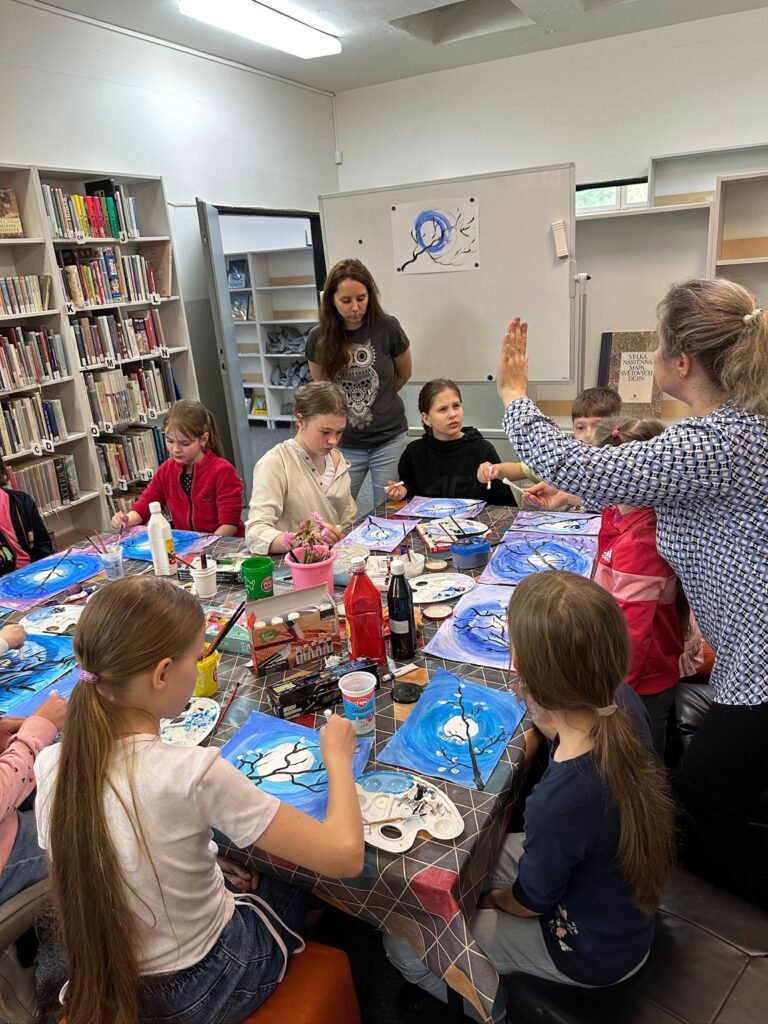
As the summer went on, the humanitarian response organised by the foundation gradually slowed down. Around that time, I found out that People in Peril also had a team in Žilina. I got in touch with them and started volunteering at the Ukrainian House, where creative workshops for children were organised under the leadership of Natalia Romanenko.
The Ukrainian House was founded by a Ukrainian woman who has been living in Slovakia for many years. Children came there to take part in creative activities and spend time together. My role was mainly to prepare materials for the workshops and make sure everything was ready and welcoming.
Later, People in Peril began placing a stronger emphasis on inclusion, so that the activities would not be intended only for Ukrainian children, but would bring together Ukrainian and Slovak children and adults alike.

You also became involved in an inclusive theatre project. Tell us more about it. How did the project come about?
Professor Halyna Handzilevska, who had previous experience with theatre projects in Ukraine, approached People in Peril with the idea of trying something similar here in Slovakia. Halyna is a psychologist who uses the arts as a way of supporting people and promoting well-being.
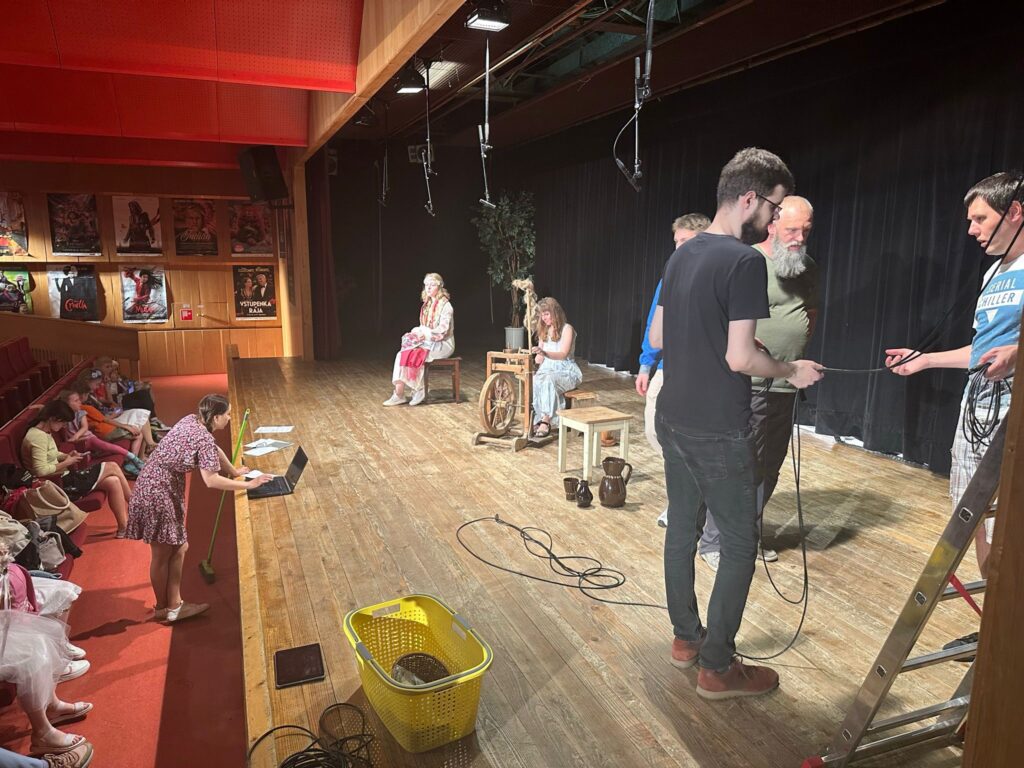
We started rehearsing a Christmas performance for the public. It brought together Slovak and Ukrainian children as well as adults. It wasn’t intended only for Ukrainians—it was a genuinely inclusive production that brought both communities together.
Where did you rehearse?
Wherever we could. We rehearsed in accommodation for people displaced by the war, as well as in church premises. The performance itself took place in the cinema hall at the University of Žilina.
Do you remember how many people came to the first performance?
Honestly, I don’t. I spent the whole time backstage behind a laptop, taking care of the music and making sure nothing went wrong so that everything ran smoothly. (laughs) But the venue was full.
What was the performance about?
I don’t remember the title, but it was a Christmas play inspired by Ukrainian culture. It was really a blend of Ukrainian and Slovak traditions. In the end, I even appeared in it myself. Another volunteer and I played parents returning home from the front to their children, who had wished for exactly that as their Christmas miracle.
What exactly is inclusive theatre, and how does it help people who have fled Ukraine?
It’s about bringing cultures and people together. In our case, it was a partnership between Ukrainians and Slovaks. Children can connect even without sharing a common language—they always find a way to understand one another. They learned Slovak and Ukrainian songs and lines together and even helped each other pronounce words correctly. It was wonderful to see that sense of community, free from prejudice, negativity and barriers.


Looking back on your volunteering with People in Peril, what has been the most valuable experience for you, and why?
Overall, it gave me the reassurance that this is the right path for me—that my name is synonymous with volunteering. Today, I’d say my name is synonymous with helping others. I’ve found what I truly want to do in life.
Is there a particular moment or experience from your time at People in Peril that has stayed with you?
There are many. I still have the little plaster magnets that the children gave me at the end of a summer camp. They’re on my fridge to this day.
When did you realise just how meaningful your work was?
If, years from now, one of those children remembers that, during one of the hardest periods of their life, they met this crazy lady in Slovakia who spoke to them in every language she could think of, communicated with her hands and feet, ran around trying to make everything work, and managed to make their day just a little bit better—that’s when I know it mattered.
What is the most challenging part of being a volunteer?
The emotional side of it. You overhear fragments of conversations about homes in occupied territories that people can no longer return to. You meet children who experience hostility simply because they’re from Ukraine, even though they’ve done nothing wrong.
People often assume that refugees live comfortably on generous benefits, but I’ve met highly educated people who had no choice but to take factory jobs. It’s difficult to want to help and know that sometimes you can’t—because of limited funding or legal restrictions.
Many people would like to volunteer but worry that they don’t have enough experience or the right skills. What would you say to someone who’s thinking about volunteering but still hesitating?
Volunteering is an incredible experience, and there’s a place for everyone. You might tutor children or simply spend time talking to Ukrainian children to help them practise Slovak. You could become a buddy to a child living in residential care—a friend and someone they can rely on—or organise leisure activities. There are so many different ways to help. The important thing is to ask yourself who you want to support and how you can contribute.
What do you wish more people understood about humanitarian and social work?
I wish people took a greater interest in this field and recognised how often NGOs step in where the state cannot. We face staff shortages and high turnover because the work is poorly paid. At the same time, there’s an enormous administrative burden, and there are rarely enough people or resources to do everything that needs to be done.
What would you say to people who feel that one person can’t make a difference?
One person can’t change the whole world, but they can change—or at least make a little better—the world of one other person.
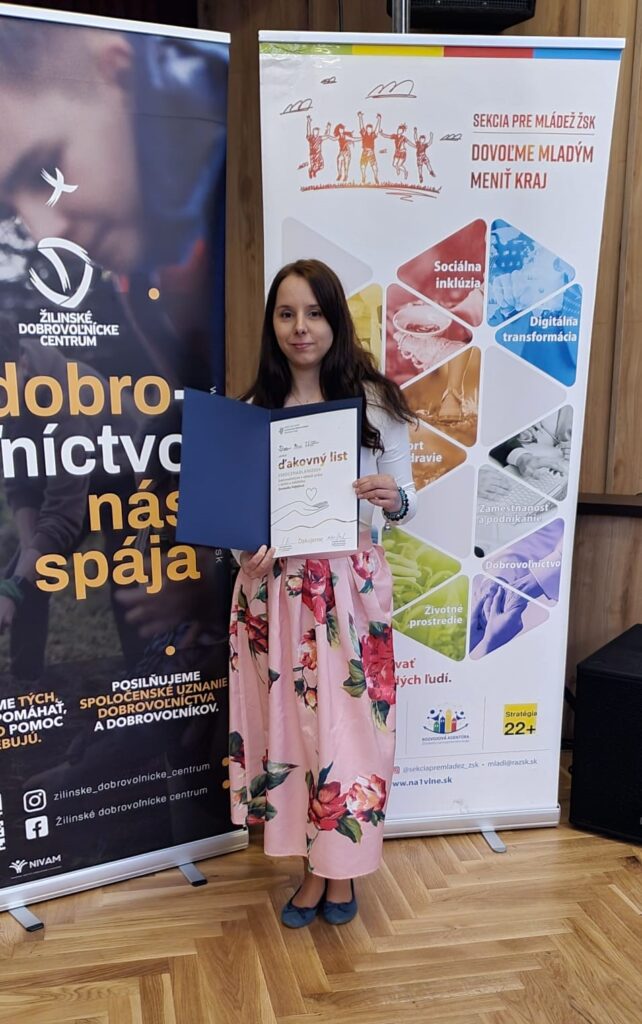
You were also nominated for the Heart in Your Hands award, which recognises outstanding volunteers. How did you feel about that?
I was completely speechless. I couldn’t understand why I had been nominated—I kept thinking there were so many “super volunteers” who deserved it more. It was a wonderful surprise, and it meant a lot to see that the organisation truly values its volunteers and lets them know how much they matter.

What’s next for you?
I’m about to start a new job as an outreach social worker supporting people experiencing homelessness. I’m really looking forward to it.
I’d like to connect the issue of displacement caused by war with the experiences of people experiencing homelessness, and I’d also like to explore this topic in my master’s thesis. At the moment, I’m preparing by listening to podcasts and learning as much as I can, so that I can start this new role with a solid understanding of the field rather than feeling like a complete beginner.
Finally, can you recommend a book, film, TV series, podcast or board game that offers insight into this kind of work or has influenced you personally?
I’d definitely recommend following People in Peril’s work—reading its articles and watching its videos. I also recommend Depaul Slovakia’s podcast, The Street Is Not a Home, which focuses on people experiencing homelessness.
As for books, I’d recommend the publications of Absynt publishing house, as well as We Are Not Dead Yet by Stanislava Harkotová. That book was especially important to me because I have to admit that I once stood on the other side—I believed pro-Russian narratives. It helped me better understand what was happening at the time and the horrors people in Ukraine were going through.
You mentioned that you once believed pro-Russian narratives. Would you be willing to explain where those views came from and what changed your perspective?
Honestly, I’m not even sure. I simply saw Russia as a huge and powerful country that no one could really stand up to. Back in 2014, I believed Ukrainians were the ones in the wrong, simply because Russia seemed so powerful.
Later, I began noticing obvious grammatical mistakes and increasingly exaggerated, fantastical claims in propaganda articles. At some point they became so implausible that I stopped reading them altogether. Gradually, I broke away from that influence and became much more critical of the information I consumed.
Through my colleagues—and later through People in Peril—I also came to understand the reality of life in Ukraine. Today, I always encourage people to verify information from multiple sources and not to believe everything they read straight away.
Dominika Vojtylová
Dominika Vojtylová was born in Žilina and holds a bachelor’s degree in Social Work. She has been volunteering with People in Peril since 2022, when she joined the organisation’s response to support people fleeing the war in Ukraine. Over the years, she has contributed to humanitarian assistance, creative activities for children from Ukraine, and an inclusive theatre project that brought together Ukrainian and Slovak communities. She is now preparing to begin her work as an outreach social worker and hopes to dedicate her career to supporting people facing extreme hardship after losing their homes, security or sense of stability.