The journey to work begins with trust, not a résumé
Finding a job is not always just about writing a résumé or submitting an application. For many people, the hardest part is taking the very first step. Through our POKROK (“Progress”) project, we support people who have been out of the labour market for a long time, helping them build confidence, develop work habits, and gain the support they need to find and keep a job.
Some people are unemployed for a few months. Others for years. And some have never had a job at all, leaving them with little understanding of what working life actually involves. Their situation is often shaped by a combination of barriers, such as low levels of education, health issues, caring responsibilities, limited job opportunities, or growing up in a socially disadvantaged environment.
“People cannot choose where they are born. Yet some carry a label throughout their lives simply because they were born Roma. From my perspective, they have to work much harder than someone from the majority population. They often end up caught between two worlds, not being fully accepted by either the majority society or their own community. That is why an important part of our work is building relationships with employers and breaking down prejudice, so they are willing to give an opportunity to people we know and can personally recommend,” explains Viera Rojková, Social Inclusion and Employment Specialist.
The longer a person stays out of work, the harder it becomes to return. That is why we run the POKROK (Supportive Steps Towards Employment for Economically Inactive People) project, helping people take their first steps back into the labour market.
Through one-to-one career guidance, skills development, support with job searching, and continued assistance during the first months of employment, we help participants improve their chances of finding stable work and keeping it.
We support young people under the age of 30 who are not in employment, education or training (NEETs), as well as economically inactive adults over the age of 30.
Everyone needs someone to help them take the next step
Career guidance does not begin with writing a résumé or searching for job vacancies. It begins much earlier—with building trust.

“To us, no client is ever just a number. Every person is an individual we strive to support through a difficult period in their life. Sometimes all someone needs is a guiding light—someone to walk alongside them throughout the process. Our work is about much more than writing a résumé. It also means preparing for job interviews, searching for suitable vacancies, registering with the employment office, and providing support every step of the way. We go through the entire journey together with each client,” says Viera Rojková.
Every client has a different story. Some have never had a formal job with an employment contract, while others have never worked at all and struggle to imagine what working life actually looks like. They know they want to work, but everything connected with employment often feels abstract and unfamiliar. Others lost their jobs years ago and have never returned to the labour market.
Many have no one in their lives who can advise them where to turn or how to navigate the first administrative steps. They also often lack positive role models in the communities where they live.
That is why our first meetings do not begin with the question, “What kind of job are you looking for?” Instead, we focus on getting to know each person, understanding what is preventing them from taking the first step, and working together to overcome those barriers.
Taking the first step
Returning to the labour market is often a long journey. Sometimes, simply registering with the employment office is already a significant achievement.
“I worked with two clients for about six months. At first, we focused on career guidance, but later our meetings were mainly motivational conversations, as I was waiting for them to take some initiative themselves. Then one day they came to me and said, ‘We need a résumé.’ I remember thinking, ‘Finally.’ As we started gathering the necessary information, it turned out they did not even know when they had finished primary school. A week before the summer holidays, we went back to their school together to obtain a duplicate of their school certificate, which they also needed to register with the employment office. They had to borrow two euros to pay the administrative fee and walk several kilometres to get there. After six months, we finally made it happen. Small successes like these are what give me the energy to keep going,” Viera recalls.
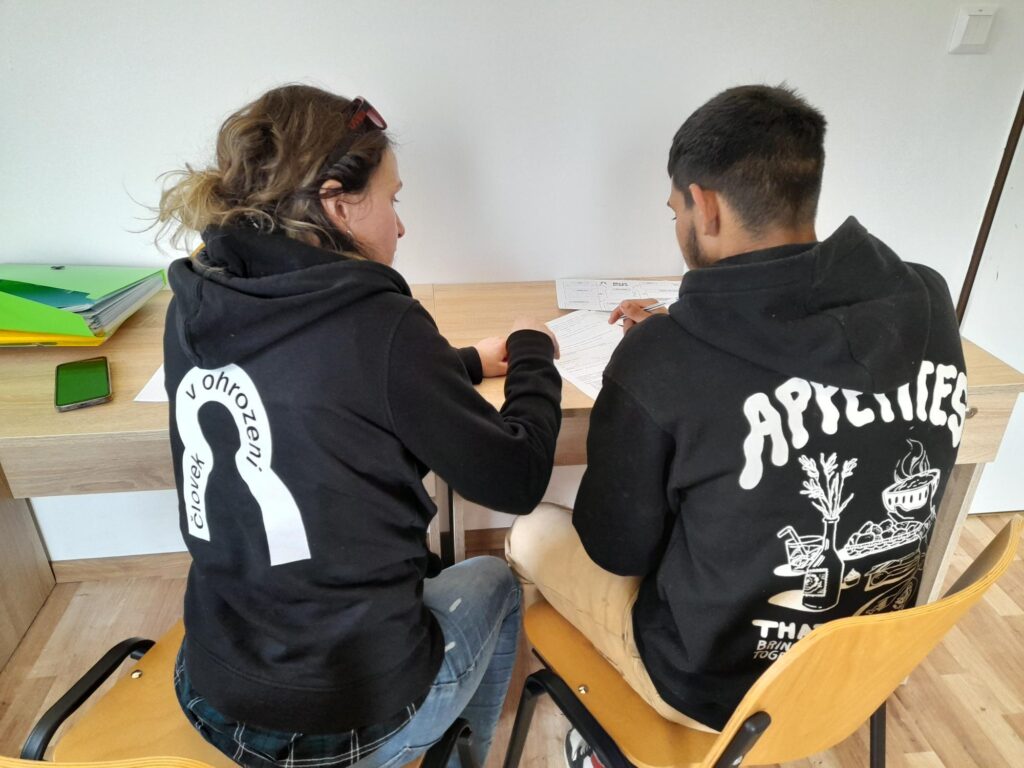
Throughout the programme, participants receive one-to-one career guidance. Together with our employment specialists, they identify their strengths, develop practical workplace skills, and prepare for job interviews. We also help them search for suitable job opportunities and, when needed, support them in communicating with employers and navigating administrative procedures.
Viera explains that many participants genuinely want to work, but are used to relying on short-term casual jobs or occasional day labour. That is why we encourage them to look for stable employment with a formal contract—work that provides a regular income, social protection, and greater security for the future.
“Casual work is not the goal. Someone may earn money today digging trenches or mowing lawns, but when winter comes, the work disappears. Many clients see the advantage of informal jobs because they are paid in cash straight away. Through the activities we do together during career guidance, they begin to understand which option will benefit them more in the long run. Our goal is for them to find stable employment, stay in work, and have a reliable source of income. That is what success looks like for us,” says Viera.
Working closely with employers is another important part of our approach. It gives participants the opportunity to experience a real workplace before starting a job. In Žilina, for example, they visited a Tesco store, where they were able to see first-hand how different departments operate.
The biggest barriers are often the ones we don’t see
For many people, the biggest challenge is not a lack of motivation but the everyday barriers that most of us rarely even notice. Some cannot afford the bus fare to the employment office. Others have lost their ID card or do not know where to look for job opportunities. Some have never attended a job interview in their lives.
“We need people to take at least one step. We will support them every step of the way, but they have to be willing to take that first step themselves. We do not make promises. We are here to offer guidance and support, but without their commitment, lasting change is not possible,” explains Viera.
That is why the foundation of our work is an individual approach and long-term relationships with each participant. Sometimes this means visiting people repeatedly in their communities, asking how they are doing and what they are going through, reminding them about upcoming appointments, or simply staying in touch until they are ready to move forward. Our role is to be there when they decide they are ready to take that next step.
Finding a job is only the beginning—keeping it matters just as much
Our work does not end when someone signs an employment contract. We continue to support participants after they start their new jobs, staying in touch with both them and their employers. We help resolve any challenges that arise in the workplace and provide ongoing support so they can build a stable and lasting career.
“Our job is not done the moment someone gets hired. What matters is that they stay in work, have a stable income, and feel accepted in their workplace. That is our real goal,” says Viera.
When Support Is No Longer Needed
The greatest reward for our team is seeing participants gain enough confidence to no longer need our support.
Viera remembers Kevin, whom she worked with for several years. Together they prepared his résumé, searched for job opportunities, and she supported him through his first work experiences. Eventually, he left to work abroad. When he later returned to Slovakia, Viera offered to help him again.
“He said to me, ‘This time, I’ll try on my own.’ That was the moment I realised what our work is really about. It’s when someone no longer needs me because they believe in themselves and know they can do it on their own,” she says.
Stories like Kevin’s show that returning to work is about much more than finding a job. Above all, it is about building self-confidence, taking responsibility, and believing that you have the power to shape your own future.
The POKROK (Supportive Steps Towards Employment for Economically Inactive People) project is funded by the European Union through the Slovakia Programme. The project runs from 1 November 2025 to 31 October 2027 and is implemented in the districts of Prešov, Levoča, Spišská Nová Ves, Košice, Žilina, Zvolen, Malacky, Pezinok, and Bratislava.